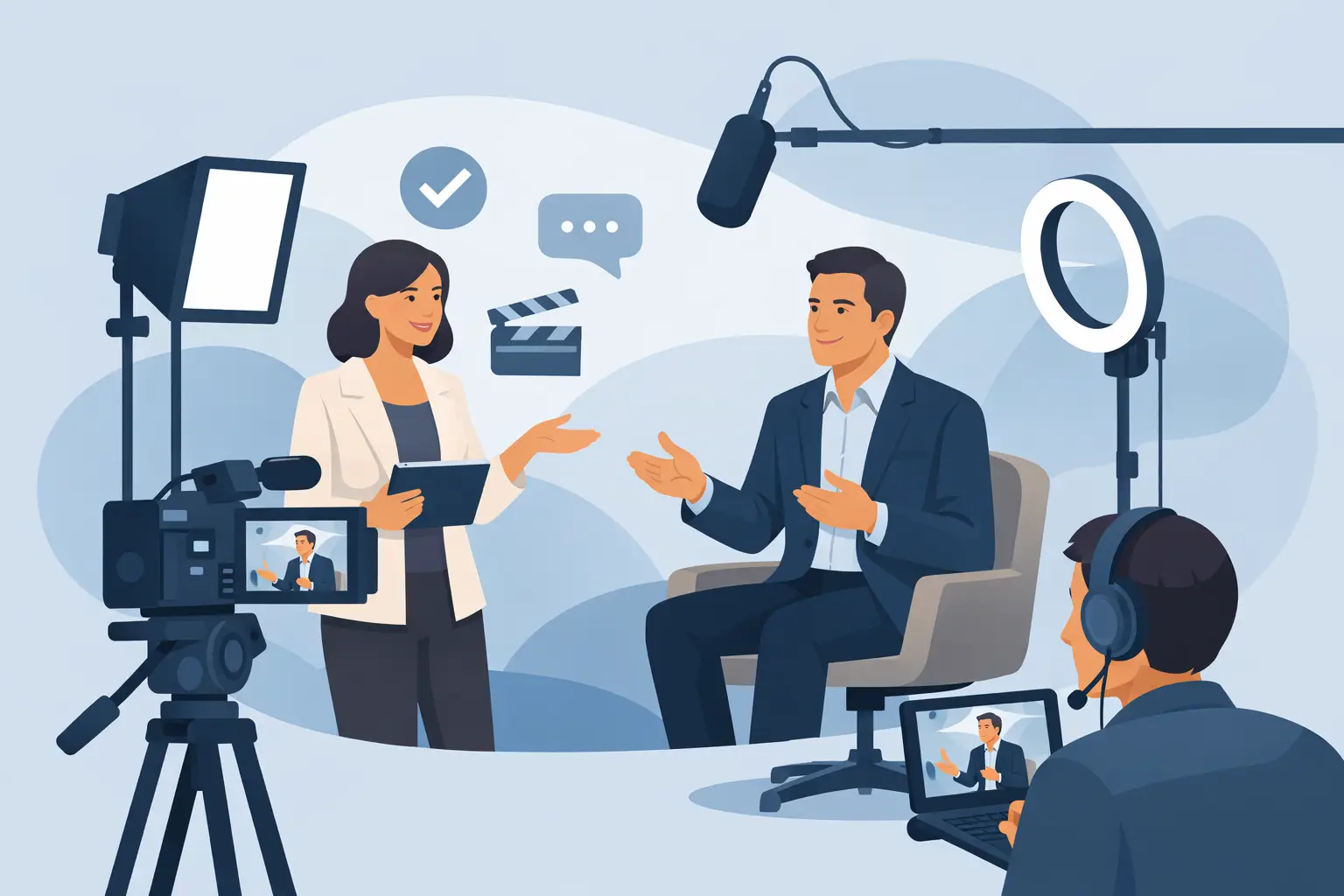
The camera can spot a rehearsed talking point from across the room. It can also capture the moment a leader stops performing, speaks plainly, and gives an audience a reason to listen. That is the real work behind how to prepare executives on camera: not turning a CEO or subject-matter expert into an actor, but creating the conditions for their authority, clarity, and personality to come through.
For a company profile, investor message, recruitment film, media interview, or social campaign, executive presence carries weight. A polished image signals preparation. A human voice builds trust. The goal is to hold both in the same frame.
Start With the Moment You Need to Create
Before anyone sits under the lights, define the job of the video. “We need an executive interview” is a production format, not a strategy. Is the leader reassuring employees after a change? Explaining a complex product? Making a case for a new market? Introducing the people behind a legacy brand?
The answer shapes every decision that follows: the location, wardrobe, energy, interview questions, b-roll, edit rhythm, and even whether the executive should speak directly to the lens. A direct-to-camera message feels immediate and personal. An off-camera interview can feel more natural and documentary-driven. Neither is automatically better. It depends on the audience and the intended emotional distance.
Give the executive one clear objective in a sentence they can remember. For example: “Make prospective clients feel confident that our team can handle high-stakes work.” This is more useful than asking them to “talk about the company.”
Build a Message Architecture, Not a Memorized Script
The fastest way to make a capable executive sound stiff is to hand them a page of copy and expect a flawless performance. Scripts have a place - legal statements, exact announcements, regulated language, and teleprompter-led presentations all demand precision. But most interviews need a framework, not a monologue.
Build three to five message pillars. Each should be a claim the audience needs to understand, supported by a proof point, an example, or a short story. If a leader says the company values innovation, the next question should be: what did that look like in practice? A specific decision, customer outcome, or turning point is where the footage starts to breathe.
Keep the language close to how the executive actually speaks. Corporate phrases may sound familiar in a boardroom, but phrases like “best-in-class solutions” flatten quickly on camera. Replace abstractions with images, facts, and verbs. “We reduced delivery time by two weeks” lands harder than “we improved operational efficiency.”
A good pre-interview conversation is the best defense against generic answers. Ask what the executive cares about, what they want people to misunderstand less often, and what story they tell when no slide deck is involved. Those answers tend to contain the voice worth protecting.
Prepare answers in beats
For each likely question, prepare a simple sequence: the point, the proof, and the human meaning. This gives an executive a reliable path without forcing every sentence into a fixed order.
For instance, an answer about a new service might begin with the customer problem, move to what the company changed, then end with the result. Short, complete thoughts also give the editing team cleaner material for broadcast, web, and social cutdowns.
Rehearse the Environment Before Rehearsing the Performance
Camera anxiety is rarely just fear of speaking. It is often a reaction to an unfamiliar room full of cables, lenses, lights, crew movement, and the pressure of knowing a statement can be replayed forever. The cure is familiarity.
Whenever possible, let the executive see the set before filming begins. Explain where they will stand or sit, where to look, how long the session will run, and what happens if they lose a thought. One of the most useful things a producer can say is: “You can stop, reset, and say that again.” It removes the false expectation of perfection.
A brief camera test is valuable for more than technical reasons. It lets the team adjust framing, posture, wardrobe, hair, and microphone placement while the executive becomes accustomed to the lens. Playback can help, but use it carefully. Some people become overly self-critical when they see themselves. If playback creates tension, keep feedback focused on one or two actionable changes rather than opening a floodgate of self-editing.
Coach for Presence, Not Personality Replacement
The strongest on-camera executives do not all have the same energy. Some are measured and precise. Some are warm, fast, and expressive. Some lead with data; others lead with conviction. Trying to manufacture a television-host persona usually produces a version of the person no one recognizes.
Instead, coach the fundamentals. Sit or stand tall without becoming rigid. Place both feet firmly. Slow down just enough to let key ideas land. Finish sentences. Let a pause exist before answering a difficult question. A pause reads as thoughtfulness on camera, not weakness.
Eye line matters. In an interview, the executive should generally speak to the interviewer just off lens, not roam around the room. For direct address, the lens becomes the audience. That shift can feel unnatural at first, so practice with a real person standing near the camera and a clear idea of who is being addressed: a customer, an employee, a partner, or a community.
Hands deserve attention, too. The goal is not to eliminate gestures. Natural gestures add life. The issue is repetitive movement, fidgeting, tapping, or holding a pen like a shield. If hands become distracting, give them a relaxed resting place and let them move only when the thought calls for it.
Get Wardrobe, Makeup, and Framing Working Together
Executive wardrobe should support the message, not compete with it. Solid colors and subtle texture tend to work well. Avoid tight stripes, tiny patterns, visible logos, noisy jewelry, and fabrics that catch light unpredictably. A dark suit may be right for a formal announcement, but it can feel overly severe for a culture-driven recruiting film. Context matters.
Encourage the executive to bring two or three options. The production team can assess them under the actual lighting and against the background. The best choice is often revealed only once the full composition is in place.
Professional grooming and makeup are not about changing someone’s appearance. They manage shine, stray hair, under-eye shadows, and the effects of high-resolution cameras. This applies to every executive, regardless of gender. The camera sees more than the naked eye, especially under cinematic lighting designed to create depth and shape.
Framing also carries meaning. A tighter composition can feel intimate and decisive. A wider frame can make room for architecture, products, employees, or an environment that reinforces the story. An office interview should not look like every other office interview if the brand has a more distinctive visual world available.
Run the Interview Like a Conversation
A producer or interviewer has a major influence on the final performance. Questions should invite stories rather than demand slogans. “What makes your company different?” is broad and likely to produce a polished answer. “Tell me about the moment you realized clients needed a different approach” creates a scene.
Listen for language that feels alive, then ask for more. If an executive says, “We had to earn trust,” ask what earning trust required. If they mention a challenge, ask what changed after it. The first answer often clears the runway. The stronger material tends to arrive after the speaker has settled into the room.
Avoid interrupting a useful answer because it ran slightly long. Let it finish, then gather a shorter version if needed. The edit needs options. A thoughtful long-form response can become the emotional spine of a brand film, while a concise restatement may become the sharp opening for a 30-second social cut.
Plan for Pressure Points and Sensitive Language
Some executive videos carry real stakes: layoffs, safety, financial performance, compliance, public response, or a major organizational transition. These situations require closer coordination between leadership, communications, legal, and production.
Prepare approved facts, boundaries, and phrases that must remain exact. Then leave space for humanity. A leader who sounds overly managed may protect the wording while losing the audience. The balance is careful: accurate enough for scrutiny, direct enough to feel present.
For high-risk messages, record a complete rehearsal or pre-interview. It reveals where the language becomes too technical, evasive, or emotionally flat before the actual shoot. It also gives the team time to refine questions instead of making corrections under pressure.
How to Prepare Executives on Camera for the Edit
Preparation should account for what happens after filming. Ask executives to repeat the essence of the question in their answer when appropriate. Instead of saying, “Absolutely,” they might say, “Our approach to client service starts with listening.” The second version can stand alone in an edit.
Leave a beat before and after each response. Avoid talking over the interviewer. If a sentence nearly lands but stumbles on one word, repeat only that sentence rather than restarting an entire answer. These small habits save time in post-production and preserve a natural cadence.
The real finish line is not a technically perfect take. It is a leader who looks composed, sounds unmistakably like themselves, and gives the audience something real to carry forward. When preparation creates that kind of space, the camera stops being an obstacle and becomes what it should be: a clear window into the people steering the story.
Explore Blue Bunny Productions’ executive interview and corporate video production for examples and production planning.
Planning executive interviews or a corporate leadership film in Miami? Request a production estimate from Blue Bunny Productions.
For executive onboarding and company-wide education, see our corporate training video production examples.