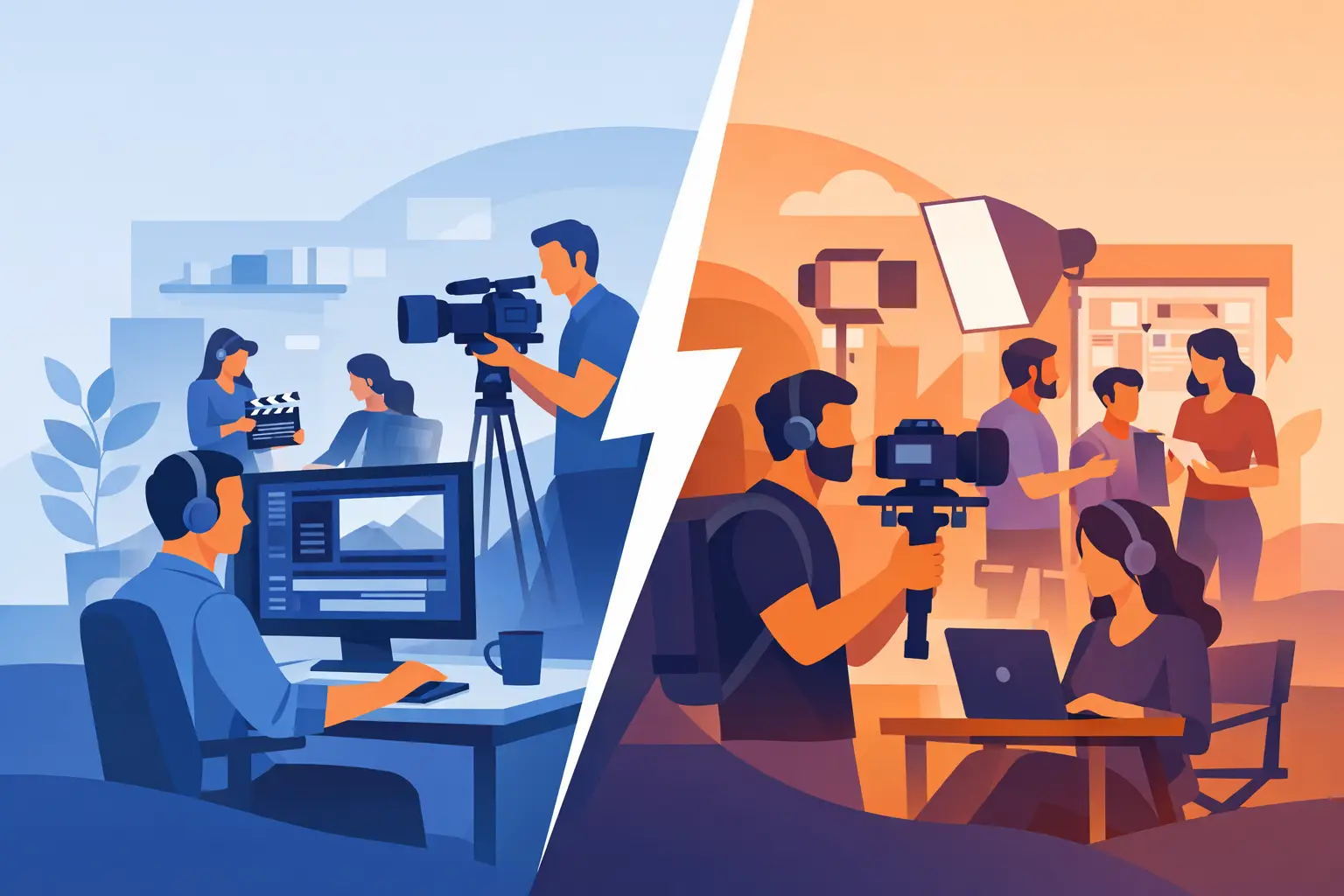
A marketing team hires a full-time videographer, buys cameras, clears out a conference room for editing, and expects content to flow faster. Six months later, deadlines still slip, social clips look fine but campaign work feels flat, and the bigger brand film keeps getting pushed to next quarter. That is where the real in house video team vs agency question begins - not in theory, but in the pressure of actual production.
For some brands, building internally is the right move. For others, an agency or production partner is the difference between content that merely fills a calendar and content that actually moves people. The smartest choice usually has less to do with ideology and more to do with volume, complexity, creative ambition, and how much internal management capacity you really have.
In house video team vs agency: what changes in practice
On paper, the distinction looks simple. An in-house team lives inside your brand every day. An agency or external production company comes in with outside perspective, specialized talent, and a broader production engine.
In practice, the difference is more dramatic. An internal team is often optimized for familiarity and speed. They know the product, the stakeholders, the legal guardrails, the internal politics, and the tone of the brand without needing a long onboarding curve. That can make recurring content easier to produce, especially if you need weekly updates, training videos, internal communications, or always-on social assets.
An agency is usually optimized for range and lift. It can scale crew size, bring in directors, cinematographers, editors, drone operators, motion graphics artists, audio specialists, producers, and photographers as needed. That matters when the assignment is larger than a quick shoot day. If the work calls for campaign thinking, cinematic polish, multi-location logistics, or a sharper visual language, an external partner often has more depth on the bench.
The catch is that neither model is automatically better. Each one shines under different production conditions.
When an in-house video team makes sense
If your brand needs a constant stream of content, internal production can be a smart long-term asset. Think product demos, executive messages, recruiting content, simple customer stories, event recaps, and social video that needs to be turned around quickly. In-house teams are close to the pulse. They can grab a camera when something happens, respond to a trend fast, and capture brand moments without waiting for a proposal, contract, or production schedule.
There is also a practical comfort in having talent down the hall. Revisions are easier to discuss face to face. Teams build shorthand. Leadership can feel more in control of the process because the production function sits inside the business, not outside it.
But here is the part companies often underestimate: an in-house team still needs structure. Cameras and editing software do not create a production department. You need someone who can produce, someone who can shoot well, someone who can shape story, someone who can handle post, and someone who can manage workflow. One person can wear multiple hats, but only up to a point. Once expectations rise, bottlenecks appear quickly.
Internal teams also tend to get trapped by proximity. Because they are accessible, everyone wants something. The result is often a flood of small requests that eat the calendar and leave no room for stronger, more strategic work.
When an agency is the better fit
An agency or production company becomes especially valuable when the project has stakes. A brand anthem video, launch campaign, investor piece, recruitment film, documentary-style profile, commercial, or large event capture usually needs more than one capable generalist. It needs concept development, pre-production, crew coordination, lighting, art direction, sound, post-production discipline, and a point of view that can elevate the material.
That outside perspective matters more than many brands expect. Internal teams know the brand intimately, but familiarity can flatten creative decisions. You stop seeing what is fresh because you are too close to the message. An external team can challenge lazy framing, sharpen the story, and build visuals that feel intentional rather than routine.
Agencies also absorb complexity well. If a project includes multiple interview subjects, location management, live streaming, motion graphics, drone work, photography, color grading, and social cutdowns, an experienced production partner can run the whole machine without forcing your marketing team to become a studio manager overnight.
For brands that need content to look high-end in front of clients, investors, audiences, or the public, polish is not a vanity metric. It is credibility on screen.
Cost is rarely as simple as salary vs invoice
This is where the in house video team vs agency debate gets distorted. Companies often compare a salary to a project fee and assume internal is cheaper. Sometimes it is. Often it is not.
An in-house team carries ongoing costs beyond payroll: cameras, lenses, lights, grip, audio kits, editing systems, software subscriptions, storage, insurance, studio space, maintenance, freelance overflow help, training, and replacement cycles. Then there is the hidden management cost. Someone has to direct the team, prioritize projects, and protect quality.
An agency looks more expensive because the cost is visible and concentrated. But you are paying for a full ecosystem that already exists. You are not building it from scratch. For brands with periodic high-impact needs, that can be more efficient than funding internal infrastructure all year long.
The more useful question is not Which is cheaper? It is What are we producing, how often, and how good does it need to be?
If you need daily content, internal may win on economics. If you need fewer pieces with more cinematic force, external often makes more financial sense.
Speed depends on what kind of speed you need
Internal teams are usually faster at reactive content. They are present, available, and already immersed in the brand. If your CEO needs a same-day message or your social team needs quick edits after an event, in-house has a real advantage.
Agencies are often faster at large-scale execution because they have a system. They can assign the right people to the job, schedule efficiently, and move through production phases without improvising every step. What feels slower at the start because of briefing and planning can actually be faster overall once the scope expands.
There is also a difference between turnaround speed and decision speed. Many delayed productions are not delayed by the crew. They are delayed by internal approvals. An agency cannot solve a confused client process. A strong internal team cannot either.
Quality is not just about image sharpness
A lot of companies judge video quality by equipment. That is the wrong lens. Great work comes from story sense, composition, pacing, sound, lighting, editing rhythm, and the ability to make a brand feel alive instead of merely documented.
An internal team can absolutely produce excellent work, especially when it is staffed with experienced creatives and given enough room to focus. But many in-house teams are hired to be efficient first and visionary second. They become content factories. Useful, yes. Memorable, not always.
An agency usually has an advantage when the brand wants stronger creative direction or a more cinematic finish. That is especially true when a project needs to feel premium across platforms, from website hero videos to paid campaigns and event screens. A studio like Blue Bunny Productions is built for that intersection where strategy meets image-making and every frame has to carry commercial purpose with visual weight.
The strongest answer might be both
Many brands do best with a hybrid model. Keep an internal team for recurring content, fast-turn requests, and day-to-day brand storytelling. Bring in an agency for flagship campaigns, high-visibility launches, major events, or moments when the visual standard needs to jump.
This model gives you speed without sacrificing scale. It also protects your internal team from being stretched into roles they were never meant to cover. Not every staff videographer should be expected to direct a commercial, manage a ten-person crew, and deliver motion graphics-heavy post on a compressed timeline.
Hybrid setups also tend to produce better creative tension. Internal teams preserve brand continuity. External teams inject perspective. That combination can keep content sharp instead of repetitive.
How to choose without guessing
Before deciding, look at your production reality with clear eyes. How much content do you actually need each month? What percentage is quick-turn and what percentage is high-stakes? Do you have leadership that understands creative production well enough to manage an internal team? Are you trying to document activity, or are you trying to shape perception?
If your content needs are frequent, repeatable, and relatively standardized, in-house can be a smart build. If your brand needs stronger concepts, broader capabilities, and more refined execution, an agency will likely create more value. If your needs swing between those extremes, hybrid is probably the honest answer.
The best video model is the one that matches your ambition, not just your org chart. Content fills space. Film creates presence. If your brand is ready to be seen with more clarity, more style, and more intention, choose the structure that gives your story the room it deserves.
Explore Blue Bunny Productions’ Miami corporate video production services for examples and production planning.
Considering an external crew for your next brand project? Request a commercial video production estimate with Blue Bunny Productions in Miami.
Compare agency capabilities with real examples in our video production portfolio.